
Learn how to write an affiliate product review using honest research, comparisons, and buyer evidence — without pretending you’ve personally used the product.
Affiliate Disclosure: Some links in this article may be affiliate links. If you make a purchase through one of these links, I may earn a small commission at no extra cost to you.
There’s an awkward moment waiting for almost every new affiliate marketer.
You’ve found a product that fits your article.
You’ve researched the keyword.
You’ve opened a blank page ready to write the review.
Then you realise something.
You’ve never actually used the product.
Now what?
Do you abandon the article?
Buy every product you ever intend to mention?
Or do what some websites appear to do and suddenly develop an amazingly detailed memory of using something you’ve never even taken out of its box?
I’d rule out option three immediately.
If you’re learning how to write an affiliate product review, there’s an important distinction worth understanding:
You don’t necessarily need personal experience to write useful product content. But you do need to be truthful about the experience you have.
If you’ve used the product, say so.
If you haven’t, don’t imply that you have.
Instead, earn the reader’s attention through something else:
Good research.
A Product Review Doesn’t Need an Imaginary Backstory
Suppose I’m researching a sewing machine.
I’ve never owned that particular model.
There are still plenty of useful questions I can investigate.
How large is it?
How heavy is it?
Which stitches does it offer?
Is it designed for beginners?
What accessories are included?
What does the instruction manual tell me?
What do owners repeatedly praise?
What problems repeatedly appear?
How does its price compare with similar machines?
Is there a simpler alternative?
Those answers could be genuinely useful to somebody considering the machine.
What I can’t honestly tell them is:
“After sewing with it for three months, I found the controls extremely intuitive.”
Unless I’ve actually done that.
That’s where the line is.

Research Isn’t the Same as Experience
This distinction deserves its own section because it’s remarkably easy to blur.
Imagine a manufacturer lists a vacuum cleaner at 4.2 kg.
You’ve also researched two competing machines weighing less.
You could reasonably write:
“At 4.2 kg according to the manufacturer’s specifications, this model is heavier than the two alternatives I’ve compared.”
That’s research.
Now compare it with:
“I found it a little heavy when carrying it upstairs.”
That’s personal experience.
If you’ve never carried the vacuum cleaner anywhere, your imaginary staircase doesn’t count as product testing. 😂
Both types of information can be useful.
They’re simply different types of evidence.
The problem isn’t writing without first-hand experience.
The problem is presenting research as though it were first-hand experience.
What Can You Say If You Haven’t Used the Product?
Quite a lot.
You can report verifiable specifications.
You can compare dimensions, capacity, weight, materials, included accessories, warranties and other documented features.
You can explain who those features appear designed for.
You can compare the product with alternatives.
You can identify patterns in customer feedback.
You can investigate common complaints.
You can discuss price and value.
You can explain limitations supported by your research.
And you can tell readers that you haven’t personally tested it.
That final sentence isn’t something to fear.
A simple disclosure such as:
“I haven’t personally tested this model, so this review is based on product documentation, specifications, owner feedback and comparison with similar products.”
immediately tells the reader what kind of article they’re reading.
No theatre required.
Start With the Manufacturer — But Don’t Finish There
The manufacturer’s website is an obvious place to begin.
You’ll often find:
Product dimensions.
Weight.
Materials.
Capacity.
Compatibility.
Included accessories.
Warranty information.
Technical specifications.
Instructions.
Sometimes downloadable manuals.
All useful.
But remember what a manufacturer is trying to do.
Sell its product.
That’s perfectly normal.
What its product page probably won’t emphasise is that the controls are awkward, a compartment is annoyingly small or a particular feature sounds more useful than it turns out to be.
So manufacturer information gives you facts.
It shouldn’t automatically give you your verdict.

Product Manuals Are Surprisingly Useful
I wouldn’t have expected instruction manuals to be particularly exciting reading when I started learning this stuff.
And, to be fair, they’re generally not.
Nobody is curling up on a Saturday night with a 74-page vacuum cleaner manual and a glass of wine.
At least I hope not. 😂
But manuals can be extremely useful for affiliate research.
They can reveal things a short sales page doesn’t explain particularly well.
How complicated is setup?
What maintenance is required?
Which accessories work with the product?
Are replacement parts mentioned?
How often does something need cleaning?
Are there operating restrictions?
Does a supposedly simple product have a surprisingly complicated routine behind it?
Those details can help you understand what ownership may involve without pretending you’ve personally owned it.
Look for Patterns in Owner Feedback
Customer reviews can be useful, but I wouldn’t build an article around one angry customer or one delighted customer.
People have different expectations.
Someone might award one star because delivery was late.
Another might award five stars before they’ve even properly used the product.
What interests me more is repetition.
Suppose you read a substantial selection of owner feedback and keep seeing variations of:
“Easy to set up.”
“Simple controls.”
“Good for beginners.”
That’s a pattern worth investigating.
Now suppose another phrase keeps appearing:
“Storage compartment is smaller than expected.”
Again, that’s useful.
But be careful with the language.
Rather than writing:
“The storage compartment is too small.”
you might say:
“A recurring complaint among owners is that the storage compartment feels limited.”
You’ve accurately described the evidence instead of converting somebody else’s experience into your own.
Don’t Cherry-Pick Reviews to Support the Answer You Already Want
This is another trap.
Imagine you’ve already decided Product A will be your top recommendation.
Now you start researching.
You find eight positive comments.
Excellent.
Then three recurring complaints appear.
It can be tempting to quietly ignore them because they’re inconvenient.
But that’s exactly the information the reader may need.
Research shouldn’t be:
“How do I prove this product is brilliant?”
It should be:
“What can I reasonably learn about this product?”
Sometimes your research will strengthen the recommendation.
Sometimes it will weaken it.
And occasionally you’ll discover the product you planned to recommend shouldn’t be your recommendation at all.
That’s not failed research.
That’s research doing its job.
⭐ Steve’s Tip
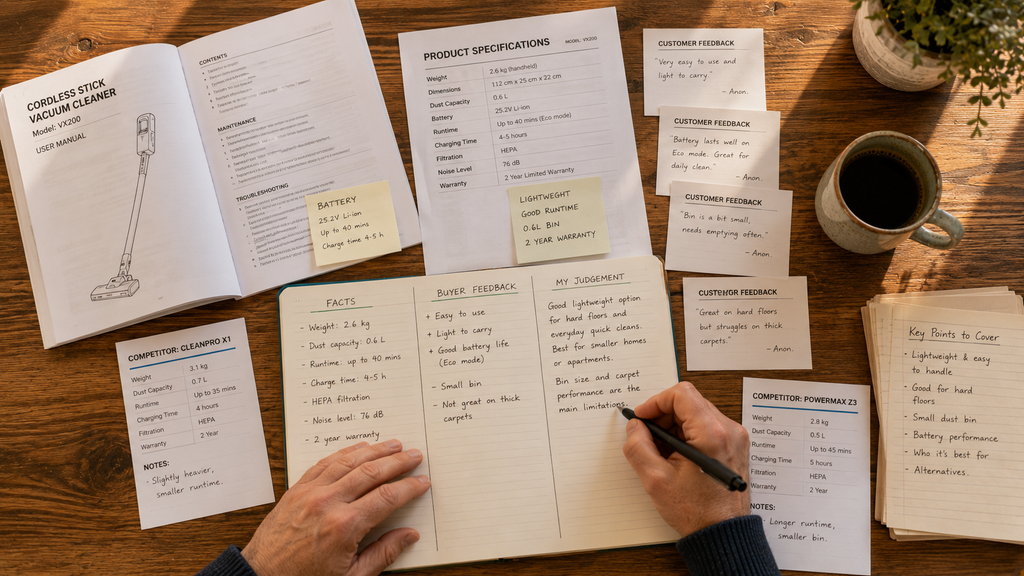
Before researching a product, open a page in your notebook and create two headings:
Reasons to Choose It
Reasons Not to Choose It
Then deliberately look for evidence for both.
It’s surprisingly effective.
If you only search for “Product X benefits”, you’ll probably find benefits.
Try searching for its limitations too.
A recommendation becomes much more useful when you understand both sides.
Compare It With Something
Products make more sense in context.
A coffee maker costing £150 might sound expensive.
Compared with what?
If similar machines cost £80, that’s interesting.
If comparable models generally cost £200, £150 looks different.
The same applies to features.
Ten stitch settings.
Three-year warranty.
Twenty-litre capacity.
Forty-minute battery life.
Numbers mean more when readers can understand how they compare with realistic alternatives.
So don’t research the product in isolation.
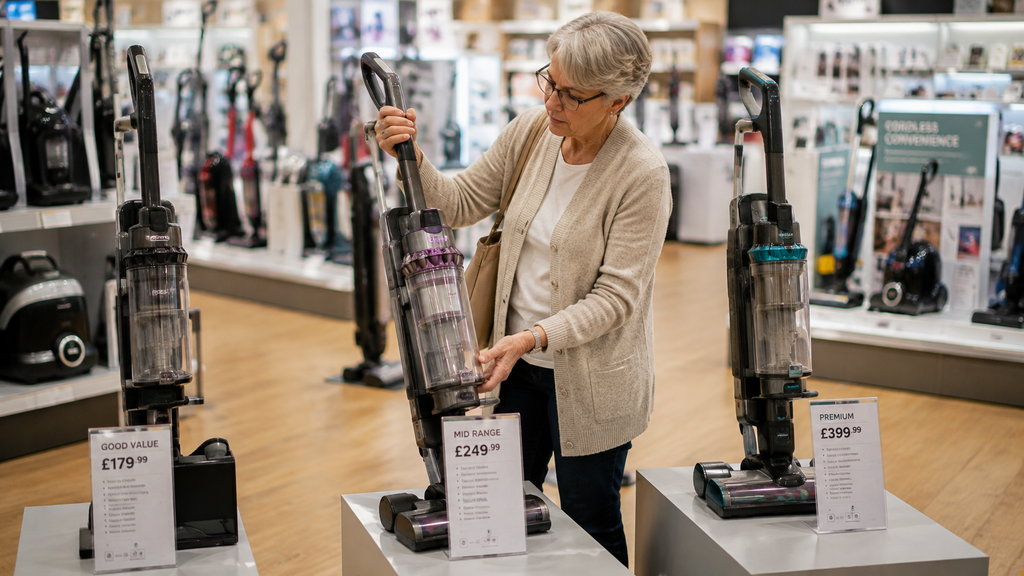
Find two or three genuine competitors.
Then ask:
What does this product do better?
What does it do worse?
What costs more?
What costs less?
What type of buyer would choose each one?

Separate Facts, Evidence and Judgement
I’ve found it useful to think of product-review statements as belonging to three different groups.
Facts
These should be verifiable.
“The manufacturer lists the capacity as 4 litres.”
Evidence
This comes from information you’ve gathered.
“Several owner reviews mention that the controls are straightforward.”
Judgement
This is your interpretation.
“That combination could make it worth considering for a beginner who values simplicity.”
Notice what happened.
We didn’t need to pretend we’d used anything.
We took a documented fact, considered supporting evidence and then explained why it might matter to a particular buyer.
That’s useful editorial work.
Tell the Reader Who It’s For
One of the weakest conclusions in a product review is:
“Overall, this is a great product.”
Great for whom?
A beginner?
Professional?
Large family?
Occasional traveller?
Small garden?
Tiny kitchen?
Someone on a tight budget?
The more precisely you can answer who it’s for, the more useful your recommendation becomes.
Instead of:
“This is an excellent camping chair.”
Try:
“This looks best suited to occasional campers who prioritise comfort over minimum packed weight.”
Now the reader can decide whether they recognise themselves.
Tell Them Who Should Skip It Too
This is the other half.
Suppose the same camping chair is comfortable but bulky.
Say so.
Best for: Car campers who have plenty of boot space and want a comfortable chair.
Not ideal for: Backpackers who need to carry everything long distances.
Suddenly the limitation isn’t merely a negative.
It’s part of matching the product to the right person.
A trustworthy affiliate review doesn’t need every reader to buy the product.
It needs the right reader to understand whether they should buy it.
Weaknesses Make Reviews More Believable — If They’re Real
There’s an old sales trick where somebody invents a tiny negative to make praise sound credible.
“This luxury car is absolutely perfect, although I wish the cup holder were half an inch wider.”
That’s not what I’m suggesting.
Look for meaningful limitations supported by evidence.
Perhaps the product:
Costs significantly more than alternatives.
Requires frequent maintenance.
Is heavier.
Has fewer settings.
Takes up more storage space.
Lacks an accessory competitors include.
Has a shorter warranty.
Those things may or may not matter to a particular reader.
Explain the trade-off.
That’s much better than adding a token “con” simply because your review template has a Pros and Cons box.
Price Is Part of the Review
A product doesn’t exist separately from its price.
Something can be excellent at £50 and difficult to recommend at £120.
Prices also change.
So rather than building your entire verdict around an exact price that may be outdated next Tuesday, think about value.
Does the product justify a premium over alternatives?
Is there a cheaper option that performs the main job nearly as well?
Are you paying for features your intended reader is unlikely to use?
Would spending slightly more buy a meaningful improvement?
This is where comparison becomes particularly useful.
Don’t Copy the Sales Page in Different Words
This is probably one of the easiest ways to produce a useless affiliate review.
Manufacturer:
“Advanced ergonomic comfort technology provides effortless everyday performance.”
Affiliate article:
“The advanced ergonomic technology provides comfortable and effortless performance every day.”
We’ve technically written a new sentence.
We’ve added almost nothing.
Instead ask:
What does this feature mean for the person considering the product?
If the manufacturer says a chair weighs 3.1 kg, the useful question might be whether that’s light or heavy compared with alternatives.
If a coffee machine has a removable water tank, the useful question might be whether that makes filling and cleaning easier.
Translate specifications into decisions.
That’s where your article earns its place.
Be Careful With “Best”
The internet has apparently discovered several million products that are all simultaneously the best.
Quite an achievement. 😂
“Best” is only useful when you define the conditions.
Best budget option.
Best for beginners.
Best for small spaces.
Best for frequent use.
Even then, you need evidence supporting the choice.
I’d rather write:
“My research suggests this is the strongest option of the three for beginners because…”
than:
“This is unquestionably the best sewing machine on the market.”
The first explains the judgement.
The second sounds like I’ve personally tested every sewing machine currently manufactured on Earth.
I haven’t.
Your Affiliate Commission Shouldn’t Write the Verdict
Yesterday we talked about choosing affiliate products without starting with the commission.
The same principle applies here.
You’ve spent hours researching a product.
Then you discover the alternative pays less commission.
Annoying.
But if the alternative is clearly better for the reader you’re writing for, that’s useful information.
Your verdict shouldn’t mysteriously change because you’ve logged into an affiliate dashboard.
Sometimes you’ll recommend the high-commission product.
Sometimes the cheaper one.
Sometimes you may conclude that neither deserves a strong recommendation.
That’s editorial independence.
And over time, I think readers can feel the difference.
A Simple Affiliate Product Review Template
Here’s a structure I’d be comfortable using.
Quick Verdict
In two or three sentences, explain what the product is, who it appears best suited to and its biggest limitation.
Best For
Describe the specific type of buyer who should consider it.
Not Ideal For
Identify who would probably be better served elsewhere.
Key Features That Actually Matter
Don’t dump the specification sheet onto the page.
Choose the features that influence a buying decision and explain why they matter.
What the Evidence Suggests Buyers Like
Summarise genuine recurring positives without presenting them as your experience.
Common Complaints
Look for repeated, meaningful criticisms.
How It Compares
Compare the product with realistic alternatives.
Price and Value
Explain whether the features appear to justify the price relative to competitors.
Who Should Buy It?
Make the use case clear.
Who Should Skip It?
Give readers permission not to buy.
Verdict
Reach a measured conclusion based on the evidence you’ve presented.
Then, if appropriate, include your affiliate link.
The link comes after the reasoning.
Not instead of it.
What If You Later Buy the Product?
Excellent.
Now your article can become stronger.
You can update it with genuine photographs.
Real observations.
Things you noticed during setup.
What surprised you.
What annoyed you.
How it performed over time.
And clearly label those sections as your personal experience.
An evidence-based review doesn’t prevent first-hand testing later.
It gives you an honest starting point until you have it.
📖 A Practical Exercise
Let’s make today’s lesson useful.
Choose one ordinary product you haven’t personally owned or tested.
Don’t write a review yet.
Research it using several types of evidence:
- Manufacturer specifications.
- The official manual or instructions, if available.
- A selection of owner feedback.
- At least two competing products.
- Current pricing and availability.
Then write five statements about the product.
For every sentence, ask:
Can I prove this?
And:
Does my wording make it sound as though I’ve personally experienced something I haven’t?
If the answer to the second question is yes, rewrite it.
For example:
❌ “The chair was extremely comfortable during long evenings at the campsite.”
If you’ve never sat in it, you don’t know that.
Try:
✅ “The chair uses a padded high-back design, and comfort is repeatedly mentioned positively in owner feedback.”
Now you’ve given the reader useful information without borrowing somebody else’s backside. 😂
Questions Readers Ask
Can I write an affiliate review without owning the product?
Yes, provided you’re transparent about the basis of the review. Research documented specifications, manuals, comparisons and owner feedback rather than implying first-hand experience you don’t have.
Should I call it a review if I haven’t personally tested it?
You can, but clarity matters. Tell readers when your assessment is research-based. Depending on the article, terms such as comparison, buying guide or product overview may sometimes describe the content more precisely.
Can I use customer reviews in my research?
Yes, as evidence of patterns and buyer experiences, but don’t simply copy reviews or treat isolated opinions as universal facts. Look for recurring themes and attribute them appropriately.
What sources should I use for product research?
Start with manufacturer specifications and official documentation, then broaden your research with reputable retailers, independent testing where available, owner feedback and competing products.
How many alternatives should I compare?
There’s no magic number. Two or three close alternatives are often enough to give a product useful context without turning the article into an endless catalogue.
What if my research shows the product isn’t very good?
Say so.
You may decide not to recommend it at all, or explain exactly which type of buyer might still find it suitable.
Discovering that a product isn’t your best recommendation is a successful piece of research.
💬 A Note from Steve
This subject matters to me because I’m building Total Home Biz while I’m learning.
I can’t buy every lawn mower, coffee machine, suitcase, garden tool or piece of software I might eventually write about.
And pretending I can would be ridiculous.
So I need another standard.
Mine is becoming:
Say what I know.
Explain what I’ve researched.
Don’t invent what I’ve experienced.
That doesn’t make an article weaker.
If anything, it gives me a clearer job.
I’m not here to pretend I’ve personally tested the contents of an entire department store.
I’m here to do enough homework that somebody considering a purchase understands the important questions before spending their money.
And when I have personally used something?
Great.
Then I can tell them that too.
The distinction isn’t complicated.
We just have to keep making it.
🧭 Keep Learning
If you’re deciding what deserves a place in your content before you begin researching, how to choose affiliate products to promote explains why reader suitability should come before commission size.
If you’re still building your first content library, how many affiliate articles do you need looks at why quality, coverage and patience matter more than chasing an arbitrary publishing number.
And if an older product review has begun losing relevance, update old blog posts or write new ones can help you decide whether the better use of your time is refreshing existing content or publishing something new.

Steve Whelan shares practical tips, tools, and resources to help make building income online simpler and more approachable. Through this website, Steve provides helpful content and recommendations, including the Plug-In Profit Site, a system designed to help beginners get started online with a website, step-by-step training, and built-in income streams. Learn more about getting started with Plug-In Profit Site here: https://www.pluginprofitsite.com/main-51568/freesetup.html