
My cabooodl review explains how the $17 affiliate marketing system works, what you actually have to do, and what beginners should know before trying it.
Affiliate Disclosure: This article contains an affiliate link to cabooodl. If you purchase through my link, I may receive a commission at no additional cost to you. Any earnings figures mentioned in this article are examples described in the cabooodl material and should not be considered typical or guaranteed results.
Affiliate marketing sounds wonderfully simple when somebody explains it in one sentence.
Recommend somebody else’s product.
A customer buys it.
You receive a commission.
What’s difficult about that?
Quite a lot, as it turns out.
You still need somewhere to send people.
You need people to actually find your content.
You need something that explains or recommends the offer.
And ultimately somebody has to decide that what you’re recommending is worth buying.
Those are exactly the things I’ve been learning while building Total Home Biz.
So when I came across something called cabooodl, it caught my attention for a simple reason.
It approaches the problem differently.
Instead of expecting me to build the entire affiliate marketing process myself, much of that process is already provided.
The basic idea is surprisingly straightforward:
Create short social media content → offer people a free PDF → the PDF contains your affiliate link → earn a commission if somebody subsequently makes a qualifying purchase through that link.
That’s the theory.
But I wanted to understand what I’d actually be getting for my money and what I’d still have to do myself.
So let’s take a proper look.
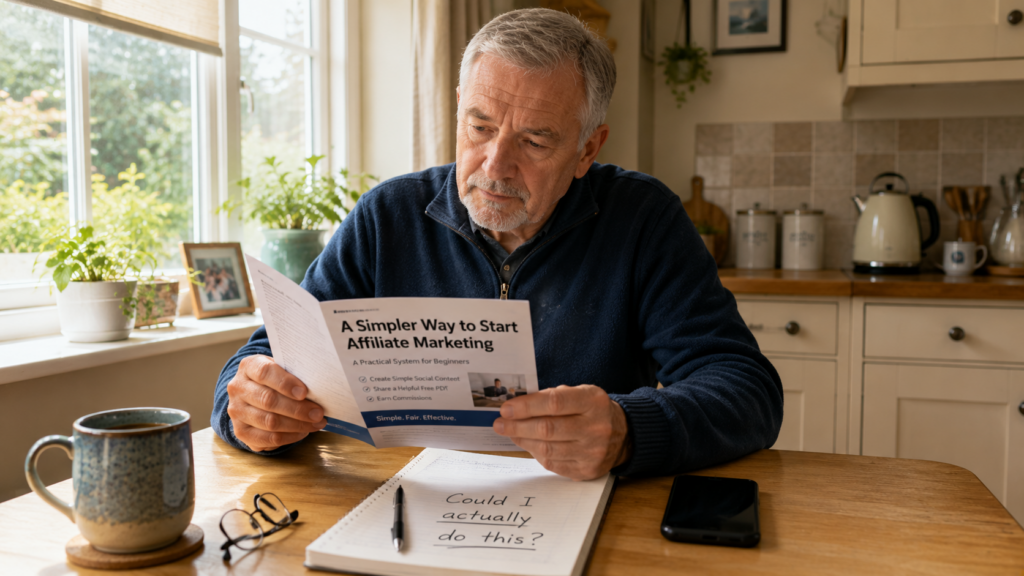
What Is Cabooodl?
Cabooodl is an affiliate marketing system created by Mark Bishop.
According to the information supplied with the system, Mark came into digital marketing after spending 28 years working in construction and didn’t begin digital marketing until he was 43.
That part interested me.
A lot of online business advertising seems to feature somebody half my age confidently explaining how easy everything is while apparently operating seventeen businesses from a swimming pool in Dubai.
That’s not particularly relatable to me.
I’m a retired warehouseman.
I’m not a programmer.
I didn’t grow up with social media.
And I’m certainly not looking to spend the next chapter of my life working 60 hours a week again.
So seeing an online-business system created by somebody who apparently hadn’t started as a teenage technology wizard made me curious enough to investigate further.
The entry price helped too.
Cabooodl is offered for a one-off $17 payment, according to the material I received. There are optional upgrades available, but the document states that they aren’t required to use the basic system.
At seventeen dollars, I was willing to see what was actually behind the door.
What Do You Get for $17?
The part that makes cabooodl different from simply joining an ordinary affiliate programme is that you’re not starting with an empty screen.
The system provides a document that becomes your PDF.
You insert your unique affiliate link into it.
That PDF then becomes the resource you offer to people who are interested in learning more.
In other words, you’re not expected to create the entire sales document yourself.
According to the supplied material, the basic system also removes the need for several things beginners commonly associate with affiliate marketing, including building separate pages, paying for a page builder, purchasing an autoresponder subscription or paying for advertising traffic.
That’s probably the biggest attraction for me.
It reduces the number of moving parts.
It doesn’t eliminate the work.
That’s an important distinction we’ll come back to.
How Does the Cabooodl PDF Method Work?
The process described in the cabooodl material has several simple stages.
First, you add your affiliate link to the supplied document to create your own version of the PDF.
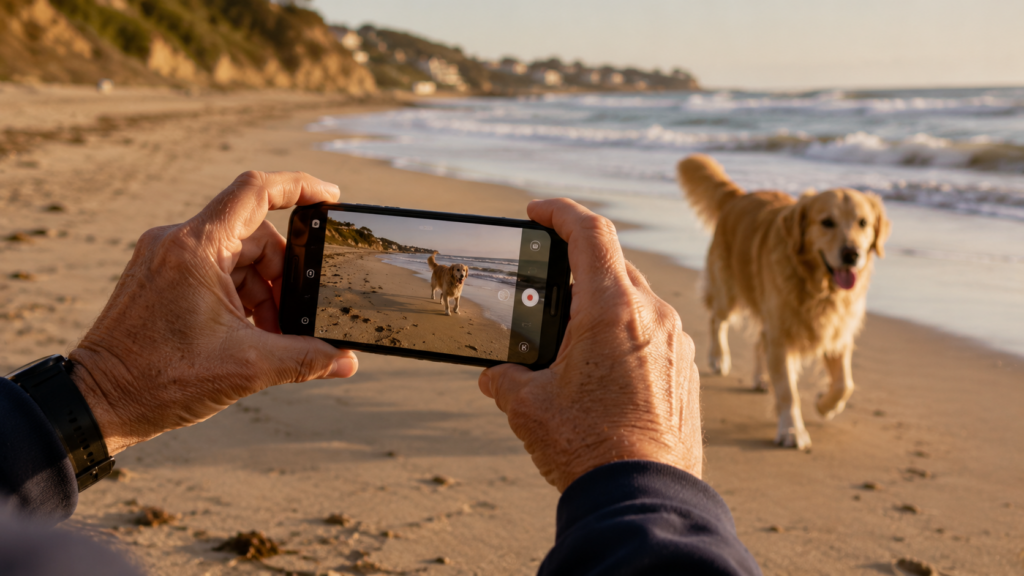
Then you create short B-roll videos for Instagram.
B-roll doesn’t require you to stand in front of the camera presenting something.
You can film ordinary scenes or subjects and add text overlays and a useful written description.
The document gives one particularly simple example: a video of Mark’s dog on a beach.
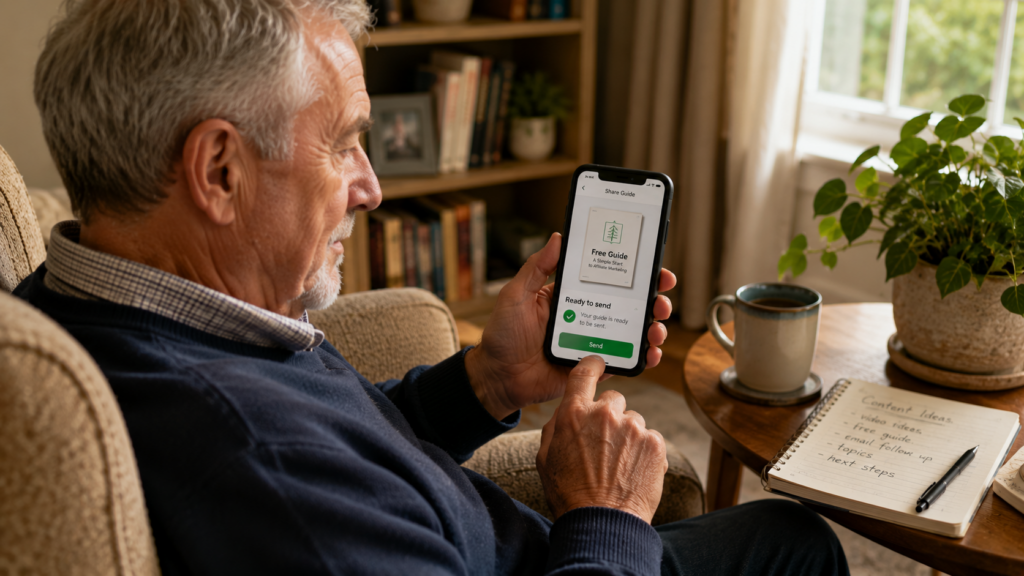
At the end of your description, you offer access to the free PDF.
Someone interested in it requests the document.
You give them the PDF.
The PDF contains your affiliate link.
If that person subsequently makes a qualifying purchase through your link, you can receive an affiliate commission.
That’s essentially the model.
Content → PDF → affiliate link → possible purchase → possible commission.
Do You Have to Appear in Videos?
This was one of the first things I wanted to know.
No, according to the instructions.
The method uses short B-roll videos, and the cabooodl material specifically states that you don’t have to appear in the videos or speak in them.
I suspect that will matter to quite a few people.
“Start making videos” can sound intimidating if your immediate mental picture is yourself standing in front of a camera trying to become an influencer.
That’s not what’s being described here.
You still have to learn how to create and post the content.
But not having to perform in front of a camera removes one obvious barrier.
Do You Need Thousands of Instagram Followers?
The cabooodl document says you don’t.
It includes an example from a new Instagram account where one B-roll video reportedly received 3,244 views, with 99.7% of those views coming from non-followers. The screenshot on page six also reports 2,618 accounts reached.
That’s an example, though — not a promise that every new account or every video will receive the same reach.
I think that distinction matters.
Social platforms decide how widely content is distributed, and I wouldn’t personally build my expectations around somebody else’s best-performing screenshot.
The useful lesson is simpler:
The method doesn’t depend entirely on already having a huge personal following.
You still need to publish content people are interested in watching.
Where Does the Money Come From?
This is affiliate marketing, so giving somebody a PDF doesn’t itself generate money.
That’s important.
Somebody ultimately has to buy something through your affiliate link.
The cabooodl material says commissions can reach $349.85, while describing $96.85 as the amount received in many of its example transactions.
It also makes clear that the commission depends upon somebody who received the PDF subsequently making a purchase.
The promotional document opens with an eye-catching example claiming $349.85 received after giving away one PDF on one day and another $543.55 after giving it away three times the following day.
I wouldn’t look at those figures and assume:
“Great. I’ll buy this for $17 and make $500 tomorrow.”
That’s not how I’d approach any affiliate opportunity.
They’re reported results, not a prediction of mine or a guarantee of yours.
What interests me more is the underlying mechanism.
Instead of trying to make a sale directly from a ten-second social media video, you’re using that short content to introduce an interested person to a more detailed resource.
That makes sense to me.
What Do You Actually Have to Do?
This is where we remove the word easy for a moment.
The PDF describes a routine of roughly an hour a day, three to five times each week, creating and uploading short B-roll videos with text overlays and useful descriptions to Instagram.
So there is work involved.
You need to:
- Create suitable B-roll content.
- Add text that gives somebody a reason to pay attention.
- Write useful descriptions.
- Publish consistently.
- Respond when somebody requests your PDF.
- Actually give them the document.
- Continue doing it even when your first few attempts don’t produce a commission.
The cabooodl document itself makes a refreshingly obvious point:
If you don’t use the system, you won’t make money from it.
Buying access isn’t the business.
Doing the work is.
⭐ Steve’s Tip
Whenever I look at an online money-making opportunity, I try to separate two questions:
“Is the system simple?”
and:
“Will the system make money?”
They’re not the same question.
A system can be easy to understand and still require patience, consistency and actual customers before you earn anything.
That’s how I’m approaching cabooodl.
What I Like About Cabooodl
The first thing is the low entry price.
Seventeen dollars isn’t nothing, but it’s very different from being asked for hundreds or thousands before you’ve even discovered whether a method suits you.
Second, much of the infrastructure is already there.
I’m not starting by trying to connect six pieces of software I don’t understand.
Third, I like the fact that the traffic method doesn’t require me to talk to a camera.
And fourth, the PDF itself does much of the explaining after somebody becomes interested.
For somebody new to affiliate marketing, reducing complexity has genuine value.
What Are My Reservations?
I wouldn’t call this review useful if I only told you what I liked.
You’re relying heavily on social media
The method described in the document centres on Instagram.
That’s very different from the SEO approach I’m using to build Total Home Biz.
With an article, I’m creating something I hope can remain useful and discoverable for a long time.
Social content can behave differently.
That doesn’t make it bad.
It means I see cabooodl as another traffic method, not a reason to abandon everything else I’m building.
You still have to create content
You don’t need to speak on camera.
Brilliant.
But somebody still has to make the B-roll, add the text, write descriptions and publish it.
That somebody is you.
Earnings aren’t guaranteed
This is the big one.
There is a huge psychological difference between:
“This system can pay commissions.”
and:
“This system will make you money.”
I believe anyone considering an affiliate opportunity should understand that difference before spending a penny.
There are optional upgrades
The supplied document says the $17 version contains what is required to use the method and that upgrades are optional.
I haven’t included claims about those upgrades here because the document doesn’t give enough detail for me to properly evaluate each one.
If I eventually use them and have something useful to report, that’s a separate conversation.
Who Might Cabooodl Suit?
Based on what I’ve seen, I think cabooodl is most interesting for somebody who:
Is new to affiliate marketing.
Doesn’t want to build complicated funnels.
Would prefer not to appear on camera.
Can spend several hours each week creating simple social content.
Is comfortable learning how Instagram works.
Understands that commissions require actual purchases.
And is willing to test a method without expecting instant income.
The cabooodl material specifically addresses concerns such as being older, having no previous experience, not being technically confident, not having an Instagram account and never having made a video before.
Those concerns certainly sound familiar to me.
Who Probably Shouldn’t Buy It?
I wouldn’t buy cabooodl if you’re looking for passive money simply because you’ve paid $17.
I wouldn’t buy it if you absolutely refuse to create social media content.
And I definitely wouldn’t buy it because you’ve seen one of the larger commission examples and decided the same result will automatically happen to you.
That’s not a sensible reason to buy any affiliate product.
The method needs activity.
The PDF needs interested readers.
And ultimately somebody needs to make a qualifying purchase before an affiliate commission exists.
If that doesn’t appeal to you, keep your seventeen dollars.
That’s a perfectly reasonable decision.
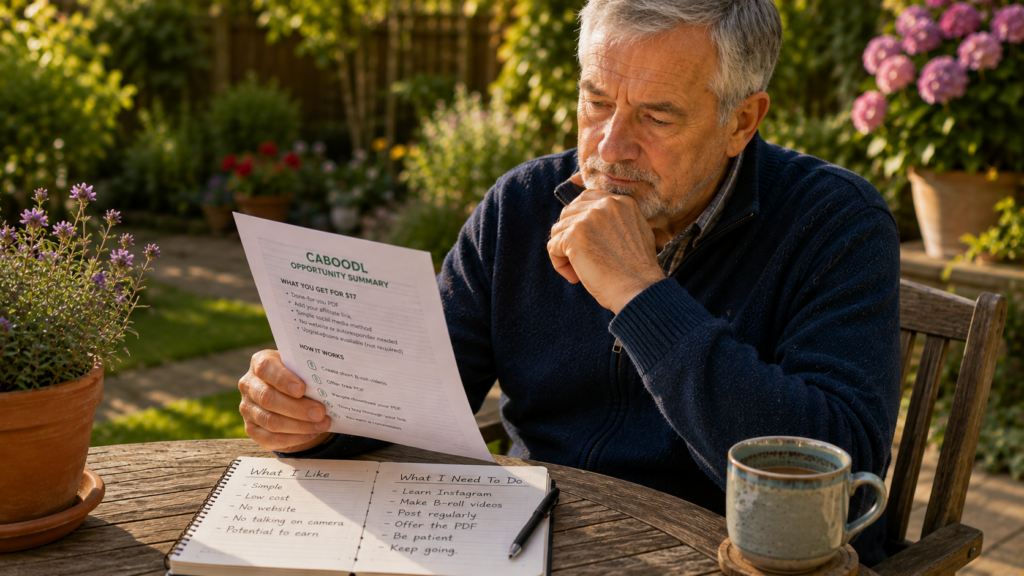
Is Cabooodl the Same as What I’m Building With Total Home Biz?
No.
And that’s actually one reason I’m interested in testing it.
With Total Home Biz, I’m building a library of useful articles designed to answer questions people are searching for.
That’s a long-term content strategy.
Cabooodl uses short-form social content to attract attention and then offers an interested person a free PDF.
Different traffic source.
Different content format.
Same underlying affiliate principle:
Help the right person discover something relevant and receive a commission if they subsequently make a qualifying purchase through your affiliate link.
I don’t see why learning one method means I have to pretend every other method doesn’t exist.
I’d rather test sensible ideas and tell you what happens.
Am I Going to Become an Instagram Influencer?
Let’s not get carried away.
Nobody needs that. 😂
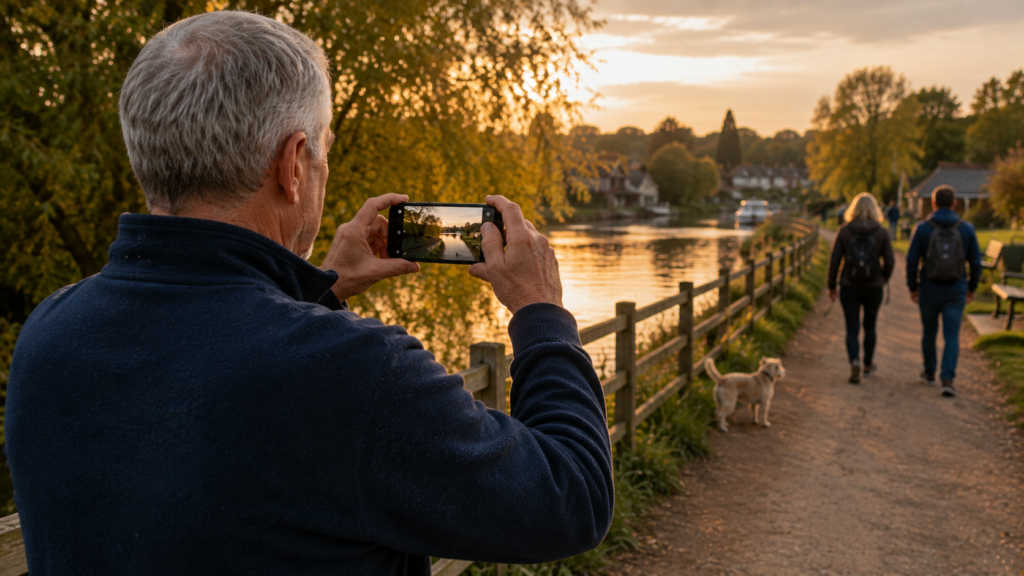
The appeal of the B-roll approach is precisely that I don’t need to spend my afternoons pointing at floating captions while dancing in the kitchen.
I can create simple footage.
Add useful text.
Write a description.
Offer the PDF.
And see what happens.
That sounds considerably more achievable.
Can You Really Make Money Giving Away a Free PDF?
Potentially, yes — but the wording matters.
You’re not being paid because you emailed somebody a PDF.
The PDF contains your affiliate link.
If somebody follows that link and makes a qualifying purchase, you may receive commission.
So the free PDF is effectively the bridge between the social media content and the affiliate offer.
No purchase means no affiliate commission.
That’s considerably less exciting than saying:
“Get paid to give away PDFs!”
But it’s also considerably more accurate.
And I prefer accurate.
Questions Readers Ask
How much does cabooodl cost?
The material I received lists the basic cabooodl system at a one-off price of $17. It also mentions optional upgrades but states they aren’t required to use the basic method.
Do I need a website to use cabooodl?
According to the supplied cabooodl document, its method doesn’t require you to build your own pages. The supplied PDF is used as the main information and affiliate resource.
Do I need to show my face?
The system’s B-roll method is specifically presented as not requiring you to appear in or narrate the videos.
Do I need an existing Instagram following?
The cabooodl material says no and provides an example of a new account receiving most of one video’s views from non-followers. That’s an example rather than a guarantee of future reach.
Is cabooodl guaranteed to make money?
No. Affiliate commissions require people to make qualifying purchases through your link. I wouldn’t treat any earnings example as a guarantee of what another user will achieve.
💬 A Note from Steve
There’s another reason I wanted to write this article.
I don’t want Total Home Biz to become a website where I sit on the sidelines explaining online business without ever trying anything.
I’m learning this stuff too.
Some things I’ll try will work.
Some probably won’t.
And occasionally I’ll spend an afternoon doing something completely useless and discover afterward that there was a button three inches to the left that would have done it for me.
That’s part of the journey.
Cabooodl interested me because it seems to remove several of the technical barriers that would have put me off affiliate marketing in the first place.
But I’m not going to tell you I’ve discovered a magic $17 money machine.
I haven’t.
I’ve discovered a simple affiliate marketing method that I think is interesting enough to test.
That’s different.
And I’d rather tell you what I actually discover than pretend I already know the ending.
📖 Your Next Step
If cabooodl interests you, read through the details before deciding anything.
Understand what you’re buying.
Understand what you’ll actually need to do.
And particularly understand that the commission examples shown in the promotional material aren’t a promise of what you’ll earn.
If the method sounds like something you’d genuinely use, you can take a closer look through my affiliate link below.
Affiliate note: If you purchase cabooodl through that link, I may receive a commission at no additional cost to you.
If it doesn’t suit you?
Don’t buy it.
There are plenty of other ways to build an affiliate business, including the SEO content approach I’m documenting here on Total Home Biz.
The right opportunity isn’t simply the one with the biggest earnings screenshot.
It’s the one you’re actually prepared to use consistently.
🧭 Keep Learning
f you’re completely new to this business model, start with what is affiliate marketing and how does it work so you understand where commissions actually come from.
If you decide to build an affiliate website alongside social media, how many affiliate articles do you need explains why there’s no magical number of posts required before a site can earn.
Once people begin interacting with your recommendations, how to track affiliate marketing results will help you understand what is actually happening rather than relying on guesswork.

Steve Whelan shares practical tips, tools, and resources to help make building income online simpler and more approachable. Through this website, Steve provides helpful content and recommendations, including the Plug-In Profit Site, a system designed to help beginners get started online with a website, step-by-step training, and built-in income streams. Learn more about getting started with Plug-In Profit Site here: https://www.pluginprofitsite.com/main-51568/freesetup.html