
Learn how to track affiliate marketing results using simple website and affiliate dashboard numbers without getting overwhelmed by analytics.
Affiliate Disclosure: Some links in this article may be affiliate links. If you make a purchase through one of these links, I may earn a small commission at no extra cost to you.
You publish an article.
A few days later, you check the numbers.
Seven visitors.
You check again after lunch.
Still seven.
Then somebody clicks an affiliate link.
Excellent.
You check the affiliate dashboard.
No sale.
An hour later, you check again.
Still no sale.
Welcome to one of the easiest traps in affiliate marketing: watching numbers that aren’t yet big enough to tell you very much.
Tracking your results is useful. In fact, once your website begins attracting visitors, it’s one of the best ways to understand what’s working and what might need improving.
But you don’t need dozens of reports, complicated spreadsheets or an expensive collection of analytics tools.
As a beginner, you really need to answer a few simple questions:
Are people finding my articles?
Are they clicking my affiliate links?
Are some of those clicks becoming sales?
Am I earning commissions?
That’s where we’ll start.
You Already Have Two Sides of the Story
Affiliate marketing results generally happen across two places.
First there’s your website.
This is where somebody discovers an article, reads your advice and perhaps decides to investigate something you’ve recommended.
Your website analytics can help you understand what’s happening here.
Then there’s the affiliate programme or network.
Once somebody follows your affiliate link, the merchant or affiliate network handles the next part of the journey.
Its dashboard may show things such as affiliate clicks, qualifying orders and commissions.
Put those two sides together and you begin seeing a simple path:
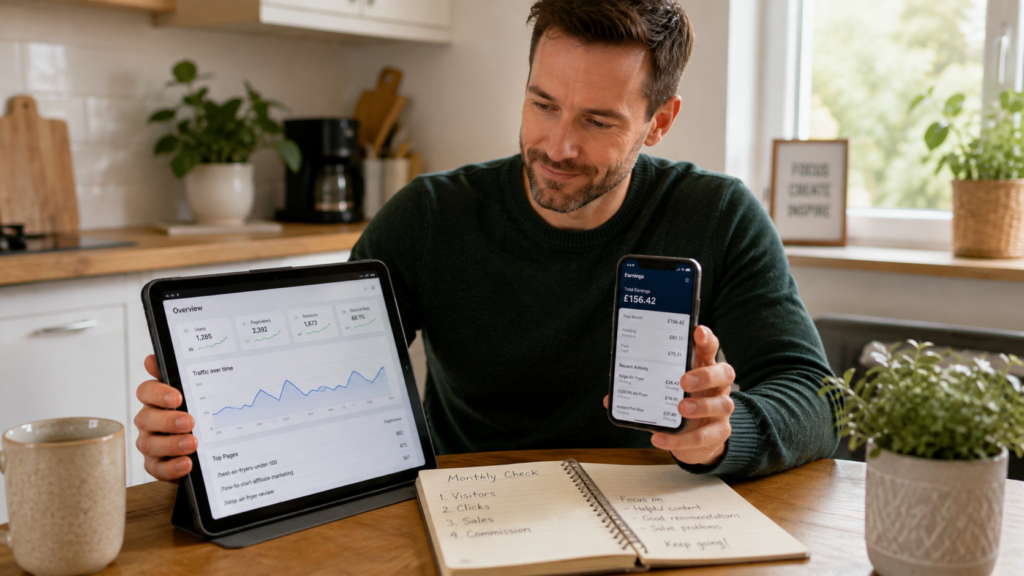
Visitors → Content → Affiliate Clicks → Qualifying Sales → Commission
You don’t need to track an individual reader around the internet.
You’re looking for patterns in the overall journey.
Start With Website Visitors
The first number I’d look at is traffic to the individual article.
Not because traffic automatically makes money.
It doesn’t.
But without visitors, nothing else has much chance to happen.
Suppose you’ve published an article reviewing an affordable air fryer.
After a while, your analytics show that people are beginning to find the article.
That’s progress.
You might also discover that another article you’ve spent hours perfecting receives hardly any visits.
That tells you something too.
If an article has no meaningful traffic, worrying about whether its affiliate buttons are converting is getting ahead of yourself.
There aren’t enough people there yet.
The first problem to solve is getting the content discovered.
Then Look at Affiliate Clicks
Now imagine your air-fryer article is receiving visitors.
The next question is:
Are any of those readers following your recommendation?
Your affiliate dashboard may record clicks on your affiliate links.
If people are clicking, you’ve learned something useful.
They aren’t necessarily ready to buy, but your content has created enough interest for them to investigate the product.
That’s an important step.
If you’re getting visitors but almost nobody ever follows a recommendation, then you have something different to investigate.
Perhaps the product doesn’t fit what the reader wanted.
Maybe the recommendation appears in the wrong place.
Perhaps you’ve given them no convincing reason to look at it.
That’s where understanding where to put affiliate links in a blog post becomes useful.

Next Come Sales
This is obviously the number everybody wants to see.
Someone clicks.
Someone buys.
Commission!
Except the journey isn’t always that tidy.
A reader can click your link and spend twenty minutes comparing products without purchasing anything.
Another may buy later.
Someone else might decide the product is too expensive.
And some referrals may not qualify for commission under the programme’s rules.
That’s why affiliate clicks but no sales doesn’t automatically mean something has gone wrong.
What matters is what happens over time and whether you have enough activity to identify a meaningful pattern.
Finally, Look at Commission
Commission is the financial result of the process.
Depending on your affiliate programme, the dashboard may show commissions as pending, approved, paid or under some similar status.
Don’t assume that seeing a commission means the money immediately belongs in your bank account.
Programmes have different validation periods, payment schedules and rules.
For now, the important thing is simply understanding where commission sits in the chain.
Someone found your content.
They followed your recommendation.
An eligible purchase occurred.
The affiliate system attributed that purchase according to its rules.
A commission appeared.
If you want to understand that part of the journey more deeply, how affiliate commissions work and how affiliate links work and how your sales are tracked explain the mechanics behind it.

⭐ Steve’s Tip
Don’t measure progress every hour.
Measure it over useful periods.
If your website is new and traffic is still small, comparing this month with last month will usually tell you far more than comparing Tuesday morning with Tuesday afternoon.
The smaller your numbers are, the easier it is for normal fluctuations to look dramatic.
Give your data room to breathe.
The Four Numbers I’d Start With
If I were beginning today, I wouldn’t build a giant spreadsheet with 27 columns.
I’d start with four numbers:
Article visitors.
Affiliate clicks.
Qualifying sales.
Commission earned.
That’s enough to begin understanding what’s happening.
You could record them once a month for your most important affiliate articles.
Nothing fancy.
Imagine one article gradually moving like this:
Month 1: Very few visitors, no affiliate activity.
Month 2: More visitors and a handful of clicks.
Month 3: Traffic continues growing, clicks increase and the first sale appears.
That’s useful progress.
The commission itself might be tiny.
But the process has started working.
What the Numbers Can Tell You
This is where tracking becomes genuinely helpful.
Different combinations point towards different questions.
Traffic is low
Concentrate on the article itself and its ability to attract visitors.
Don’t start changing affiliate links because hardly anybody has seen them.
Traffic is growing, but clicks are low
Look at the recommendation.
Does it genuinely match what the reader came for?
Is the affiliate link naturally placed?
Have you explained why the product deserves consideration?
Clicks are happening, but sales aren’t
Don’t panic.
First ask whether you have enough clicks to make a judgement.
Then consider product fit, price, reader intent and what happens after somebody reaches the retailer.
Clicks and sales are both appearing
Now you have evidence that the complete journey can work.
That doesn’t mean you should immediately redesign the article to squeeze more money out of it.
Sometimes the most intelligent optimisation strategy is:
Leave the bloody thing alone.

Don’t Compare Articles That Serve Different Purposes
Not every article should be judged by affiliate sales.
Suppose one article explains how to start affiliate marketing.
Another compares several products somebody might buy today.
Those visitors are at different stages.
The first article may attract beginners, build trust and send readers deeper into your website.
The second may naturally produce more commercial clicks.
That doesn’t make the first article useless.
This is why looking only at commission can give you a distorted picture of what your content is doing.
Some articles attract.
Some educate.
Some build confidence.
Some help readers make buying decisions.
A healthy website can need all four.
What About Conversion Rate?
You’ll hear marketers talk about conversion rates constantly.
The basic idea is straightforward: how much of one type of activity turns into another.
But I wouldn’t get obsessed with calculating percentages when your numbers are tiny.
And don’t assume every affiliate dashboard reports information in exactly the same way.
Some programmes provide more detailed reporting than others.
Use the information your particular programme gives you and learn what its terminology means.
Later, when you have enough activity, percentages and comparisons can become more useful.
At the beginning, knowing that traffic is growing, affiliate clicks are happening and occasional sales are starting to appear may tell you everything you need to know.
A Simple Monthly Affiliate Check
Once a month, sit down with your website analytics and affiliate dashboard.
Choose a few important articles.
Write down their visitors, affiliate clicks, qualifying sales and commission where those figures are available.
Then compare them with the previous month.
You’re not looking for perfection.
You’re looking for direction.
Are more people finding you?
Are recommendations being investigated?
Are sales beginning to appear?
Which articles seem to be moving forward?
Which ones have enough information behind them to justify a closer look?
Twenty or thirty minutes could be enough.
Then close the dashboard.
Seriously.
Close it.
You’ve got articles to write

Questions Readers Ask
What do I need to track affiliate marketing results?
For a simple beginner setup, your website analytics and the reporting dashboard provided by your affiliate programme or network may give you much of what you need. The exact information available varies between platforms.
How often should I check affiliate results?
There’s nothing wrong with checking occasionally, but very small daily changes can be misleading. For a newer site, reviewing trends over longer periods such as monthly intervals can provide a clearer picture.
What if I get traffic but no affiliate clicks?
Look at whether your recommendation genuinely matches the reader’s intent and whether you’ve given them a useful reason to investigate it. Also check that the link is easy to find without becoming intrusive.
What if I get clicks but no sales?
Don’t assume there’s a problem based on a small number of clicks. Readers may still be researching, comparing prices or deciding the product isn’t right for them.
Which affiliate metric matters most?
There isn’t one number that explains everything. Traffic, clicks, sales and commissions represent different stages of the same journey, so they’re more useful when considered together.
💬 A Note from Steve
I know what I’m like with numbers.
If I see something move, I want to know why.
If it doesn’t move, I want to know why that happened too.
But I’m learning that a young website doesn’t always give you enough information to answer those questions immediately.
Seven visitors isn’t a trend.
One affiliate click isn’t a strategy.
And one day without a sale certainly isn’t a disaster.
What interests me more is seeing whether the pieces are gradually beginning to connect.
People finding an article.
People reading it.
Some of them following a recommendation.
And eventually somebody deciding that recommendation was useful enough to act on.
That’s the progress I want to watch.
Not every twitch of a graph.
📖 Your Next Step
Create a very simple monthly record.
You can use a notebook, spreadsheet or whatever you’re comfortable with.
For a few important affiliate articles, record:
Visitors | Affiliate Clicks | Sales | Commission
Add the date.
Then leave it alone until your next review.
After a few months, you’ll have something much more valuable than today’s dashboard.
You’ll have history.
And history gives you context.
That’s when numbers stop being something to worry about and start becoming something you can actually learn from.
🧭 Keep Learning
If visitors are reaching your recommendations but nothing happens afterwards, where to put affiliate links in a blog post can help you improve the journey without overwhelming readers.
If those links are already receiving attention, affiliate clicks but no sales explains why interest doesn’t always become a purchase.
And to understand what happens behind the scenes once somebody follows your recommendation, continue with how affiliate links work and how your sales are tracked and how affiliate commissions work

Steve Whelan shares practical tips, tools, and resources to help make building income online simpler and more approachable. Through this website, Steve provides helpful content and recommendations, including the Plug-In Profit Site, a system designed to help beginners get started online with a website, step-by-step training, and built-in income streams. Learn more about getting started with Plug-In Profit Site here: https://www.pluginprofitsite.com/main-51568/freesetup.html