
Learn where to put affiliate links in a blog post naturally, without annoying readers or turning useful content into an obvious sales pitch.
You’ve written a useful article.
You’ve found a product that genuinely fits the subject.
You’ve even got your affiliate link ready.
Now what?
It’s tempting to think that adding the link everywhere possible gives you the best chance of earning a commission.
After all, more links must mean more clicks.
Not necessarily.
Affiliate links work best when they appear at the moment a reader has a genuine reason to use them.
Get the placement right and the link feels helpful.
Get it wrong and even a good article can start feeling like somebody following you around a shop repeatedly asking:
“Are you ready to buy yet?”
Nobody enjoys that.
Start by Helping, Not Selling
Your reader probably didn’t arrive at your article because they desperately wanted to click an affiliate link.
They arrived because they wanted an answer.
Perhaps they’re trying to choose a cordless drill, find affordable web hosting or discover which microphone is suitable for starting a podcast.
Answer that need first.
Give them enough information to understand the problem and begin trusting your guidance before asking them to go anywhere else.
This is why I wouldn’t normally cram an affiliate link into the opening sentence simply because it’s technically possible.
Earn the click.
Don’t demand it.
If you’re still getting comfortable with the mechanics behind tracking, understanding how affiliate links work makes this whole process much easier to picture.

Put the Link Where the Product Becomes Relevant
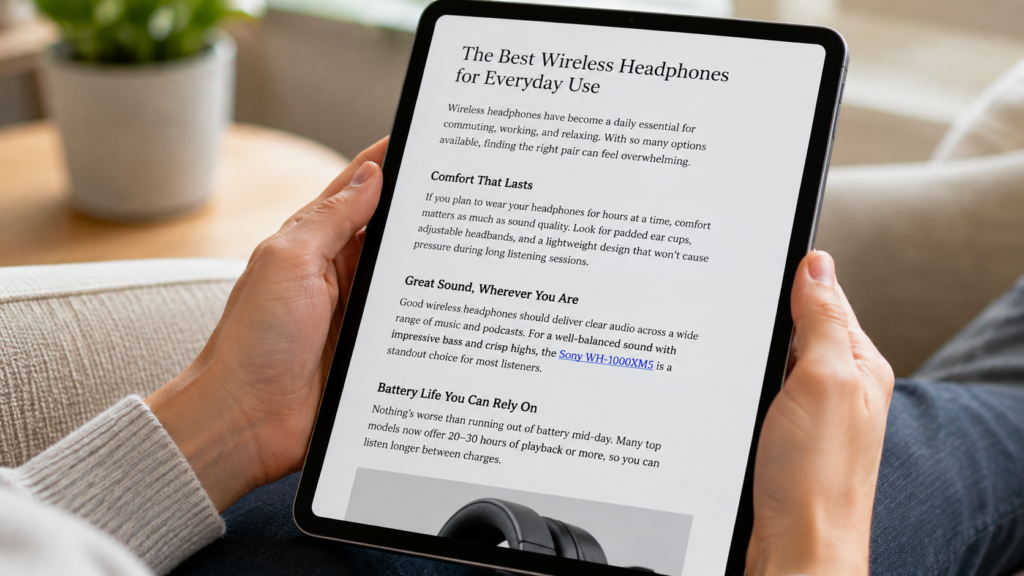
Imagine you’re explaining what a beginner should look for in wireless headphones.
You’ve discussed comfort, battery life and noise cancellation.
Then you introduce a particular model that combines those features well.
That’s a natural place to link the product name.
The reader has context.
They understand why you’re mentioning it.
And if they want to investigate further, the link is exactly where they need it.
Compare that with randomly inserting:
CLICK HERE TO BUY HEADPHONES
halfway through a paragraph about battery life.
One helps the reader continue their research.
The other interrupts them.
That difference matters.
Natural Anchor Text Usually Reads Better
The words containing a link are often called anchor text.
You don’t need to make them complicated.
If you’re recommending a particular product, the product name itself can often become the link naturally.
For example:
“For someone who values battery life, the Acme X200 wireless headphones are worth considering.”
Linking the relevant product name is cleaner than adding:
“To see them, click here.”
The sentence still reads properly even if nobody clicks anything.
That’s a useful test for almost any link you add.
How Many Affiliate Links Should You Use?
There’s no magic number.
A 700-word article recommending one product has completely different needs from a 2,500-word comparison covering ten products.
Instead of counting links, look at their purpose.
Does each link help the reader?
Is it relevant to the section around it?
Would removing it make the article less convenient?
If you’re repeatedly linking the same product every few sentences without giving the reader any new reason to click, you’ve probably gone too far.
One useful link in the right place can be more effective than five irritating ones.
The same principle applies when you’re deciding which affiliate products people actually want to buy. Relevance beats quantity.
Should You Link the Same Product More Than Once?
Sometimes, yes.
In a longer article, a reader may encounter a product near the beginning and then read another thousand words before reaching your final recommendation.
Making them scroll backwards to find the original link isn’t particularly helpful.
A second natural link can make sense.
But repetition needs a reason.
Don’t turn every mention of the product into another affiliate link simply because you can.
Think about the reader’s journey through the page rather than trying to maximise the number of clickable words.

⭐ Steve’s Tip
Before adding an affiliate link, read the sentence without the link.
Then ask:
“Does this sentence still sound like something I’d genuinely say if there were no commission involved?”
If it does, you’re probably on the right track.
If the entire sentence exists only to manufacture a click, rewrite it.
What About Affiliate Buttons?
Buttons can be useful, particularly when a reader has reached a clear decision point.
After a detailed review, for example, a simple button allowing somebody to check the product can be convenient.
But buttons are visually louder than ordinary text links.
Use too many and your article can quickly begin looking like an advert.
I prefer to think of them as signposts rather than decorations.
Put one where the reader might genuinely be ready to take the next step.
Don’t put one after every other paragraph.
And don’t rely on buttons to compensate for weak content.
A trustworthy recommendation begins with the quality of the information around it, which is why writing honest affiliate product reviews matters far more than designing an enormous BUY NOW button.
Don’t Forget Mobile Readers
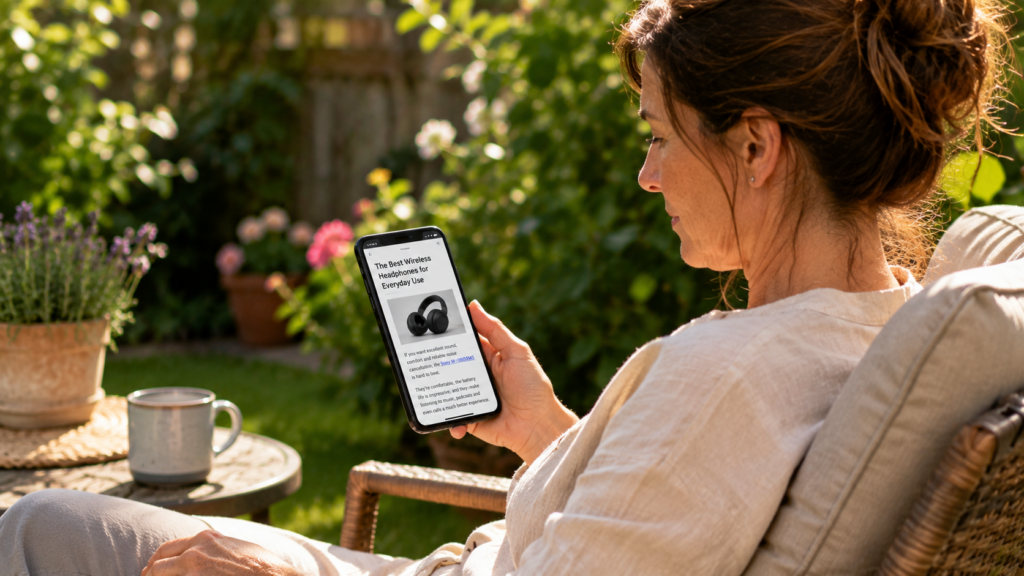
Always look at your finished article on a phone.
A page that appears clean on a large monitor can feel completely different on a smaller screen.
Several buttons, adverts and affiliate links crowded together can overwhelm the actual content.
Your reader should be able to scroll comfortably, understand what’s clickable and continue reading without accidentally tapping something they didn’t intend to.
Clean pages build confidence.
Questions Readers Ask
Should affiliate links open in a new tab?
There’s no universal rule that suits every site and programme. Think about the reader experience and check whether the affiliate programme has any requirements affecting how its links should be used.
Can I put affiliate links in images?
Some programmes may allow linked images, but individual rules vary. Check the programme’s terms rather than assuming every type of affiliate link is permitted.
Should I put an affiliate link near the top?
You can when it’s genuinely useful there, but don’t force an early link simply to get it above the fold. Give the reader enough context to understand why they might want to click.
Do I need an affiliate disclosure?
If your content contains affiliate links, disclose the relationship clearly and conspicuously. A short, readable disclosure near the beginning can do this without dominating the design.
💬 A Note from Steve
The more I’ve worked on Total Home Biz, the less I like links that announce themselves unnecessarily.
I don’t want to keep telling somebody to “click here” or “see this” when the recommendation can simply become part of the conversation.
If I’m talking about a useful product, linking its name naturally feels better to me.
The reader can carry on reading if they’re not interested.
And if they are interested, the route is already there.
That’s the kind of affiliate site I want to build — one where the links support the content rather than the content existing to support the links.

📖 Your Next Step
Choose one article containing affiliate links and read it from beginning to end as though you were a visitor.
Don’t look at commissions.
Look at the reading experience.
For every affiliate link, ask:
Why would somebody want to click this here?
If there’s a good answer, leave it.
If there isn’t, move it, rewrite the surrounding sentence or remove it.
The goal isn’t to squeeze the greatest possible number of links onto the page.
It’s to put the right link in the right place at the right moment.
🧭 Keep Learning
If affiliate tracking itself still feels mysterious, how affiliate links work and how your sales are tracked explains what happens after somebody clicks.
From there, understanding how affiliate commissions work will show you what a qualifying referral can be worth, while how to find affiliate products people actually want to buy will help make sure the products behind those links deserve recommending in the first place.
And when you’re ready to build content around a specific recommendation, how to write affiliate product reviews will help you do it without sacrificing the reader’s trust.

Steve Whelan shares practical tips, tools, and resources to help make building income online simpler and more approachable. Through this website, Steve provides helpful content and recommendations, including the Plug-In Profit Site, a system designed to help beginners get started online with a website, step-by-step training, and built-in income streams. Learn more about getting started with Plug-In Profit Site here: https://www.pluginprofitsite.com/main-51568/freesetup.html
1 thought on “Where to Put Affiliate Links in a Blog Post”